METALS: OPTIMIZING PERFORMANCE WITH RELATIVE VALUES
Riding the metals bull market as an opportunistic investor

Commodity investors can be of two kinds:
The maximalists, sometimes called “bugs”, sticking for years with the same commodity, be it gold, silver, or any other.
The opportunists, whose convictions vary more often over time, depending on the trade-offs the market currently offers.
I am of this second species.
Indeed, while sticking with one asset may pay-off at some point, this performance should be compared with the other (missed) opportunities the market offered.
Let’s see how investors could exploit them, by taking positions based on mid-term deviations from long-term trends, to generate excess returns.
TURNING BULLISH METALS
My current bullishness regarding metals, which has been in for a few years now and will likely continue for a while, is due to metals’ current positions in their respective long-term cycles.
Looking at gold (and other metals), adjusted for money supply growth, it was rather clear a few years ago that metals were in the lower end of their respective long-term cycles, where the risk is on the upside.
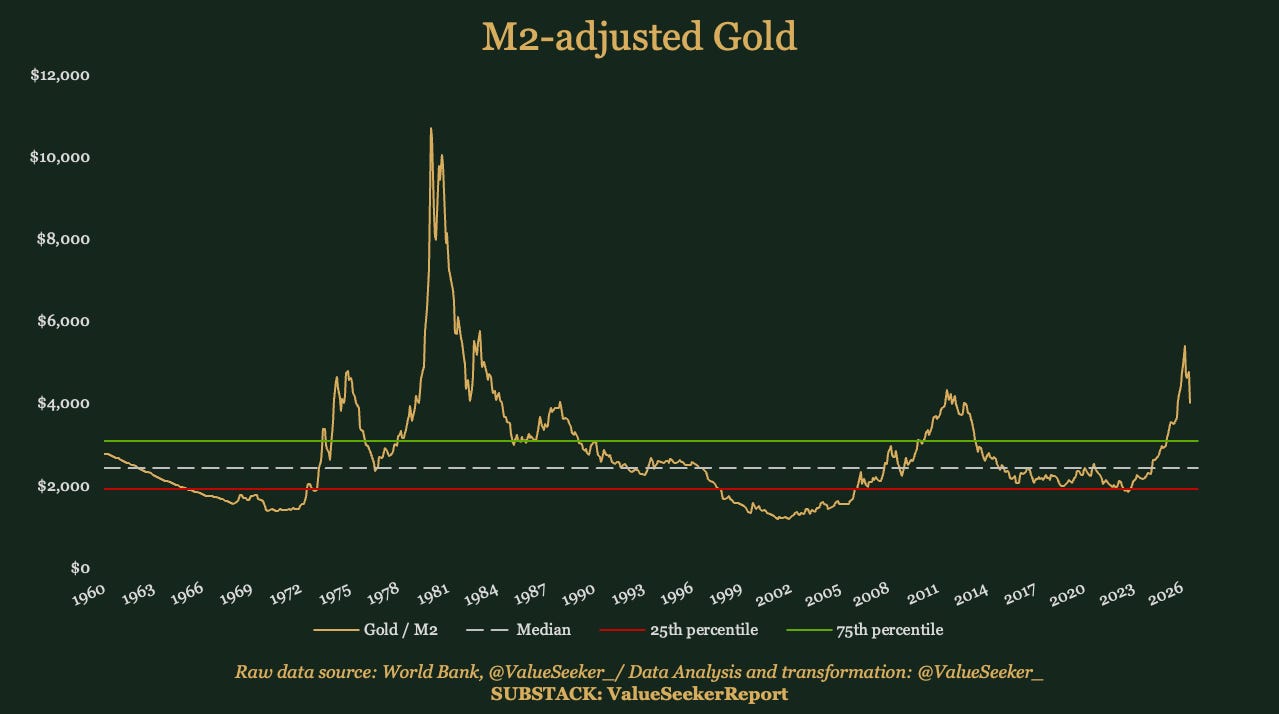
Indeed, looking at the above chart of gold, adjusted for money supply, one would have understood that:
• Gold has a linear relationship with money supply (i.e. it rises at the same pace over the long-term), as the absence of upward or downward trend demonstrate.
• But heavily deviates from it, following mid- to long-term cycles during which gold rises faster or slower than money supply, alternating from periods of undervaluation to period of overvaluation.
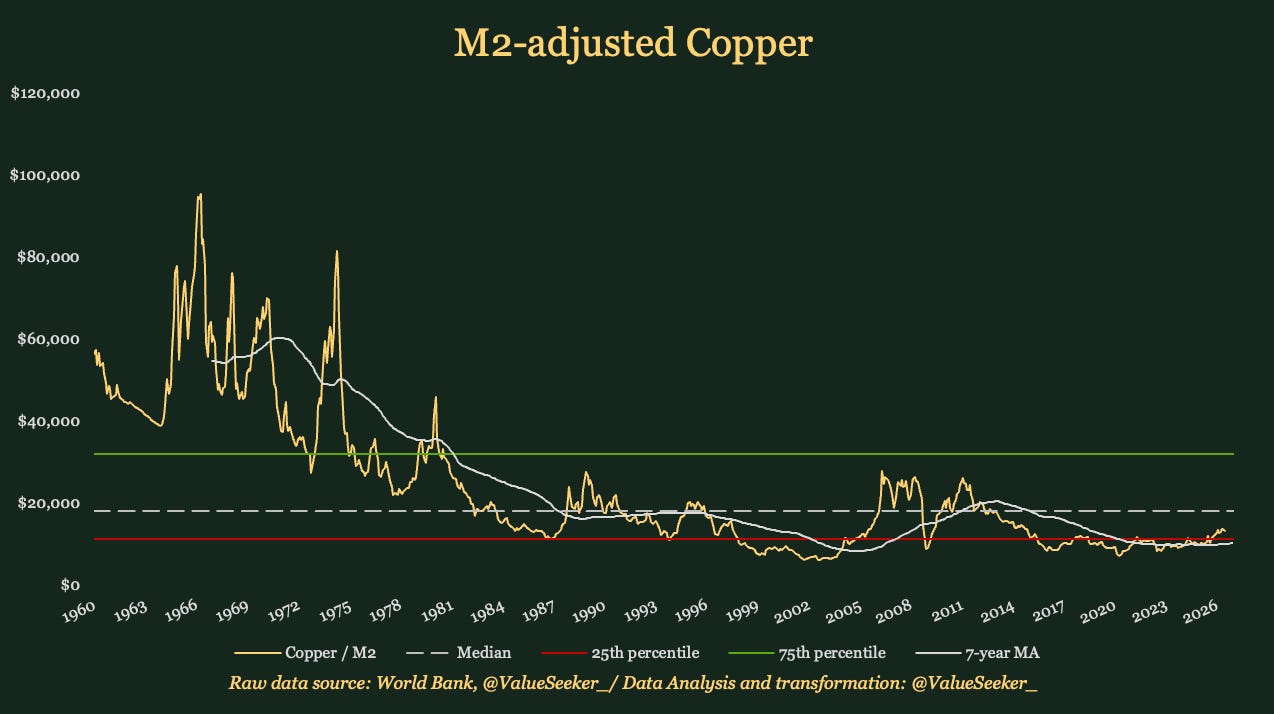
Looking now at copper, also M2-adjusted, one would have understood that, contrary to gold, the industrial metals remains in the lower end of its long-term cycle, providing a risk-reward gold offered a few years ago.
Indeed, while metals tend to move in concert over the long-term, they tend to follow different mid-term cycles, as one is lagging another before eventually catching-up later on.
This is the particularity investors could exploit to generate excess return, by overweighing the cheapest metals (playing catch-up), taking profits on the recent winners.
OVERWEIGHT INDUSTRIAL METALS
Indeed, while going long gold in 2023, when the metal (M2-adjusted) felt below its 25th percentile, seemed to be a rather promising idea, gold isn’t as cheap anymore.
While I tend to think that gold still has upside potential given the dollar’s expensiveness (thus is high likelihood to fall), other metals now offer a far better risk-reward.
Here is why I have taken most profits months ago on my gold exposure to allocate a larger part of my portfolio to lagging metals displaying an even better risk-reward.
COPPER
As explained in this note from April 2026, copper displayed then an incredibly more attractive risk-reward than gold itself when the copper-to-gold ratio reached 1.5 standard deviations below its long-term trend, as a return to the trend would have implied a 100% outperformance of copper relative to gold.
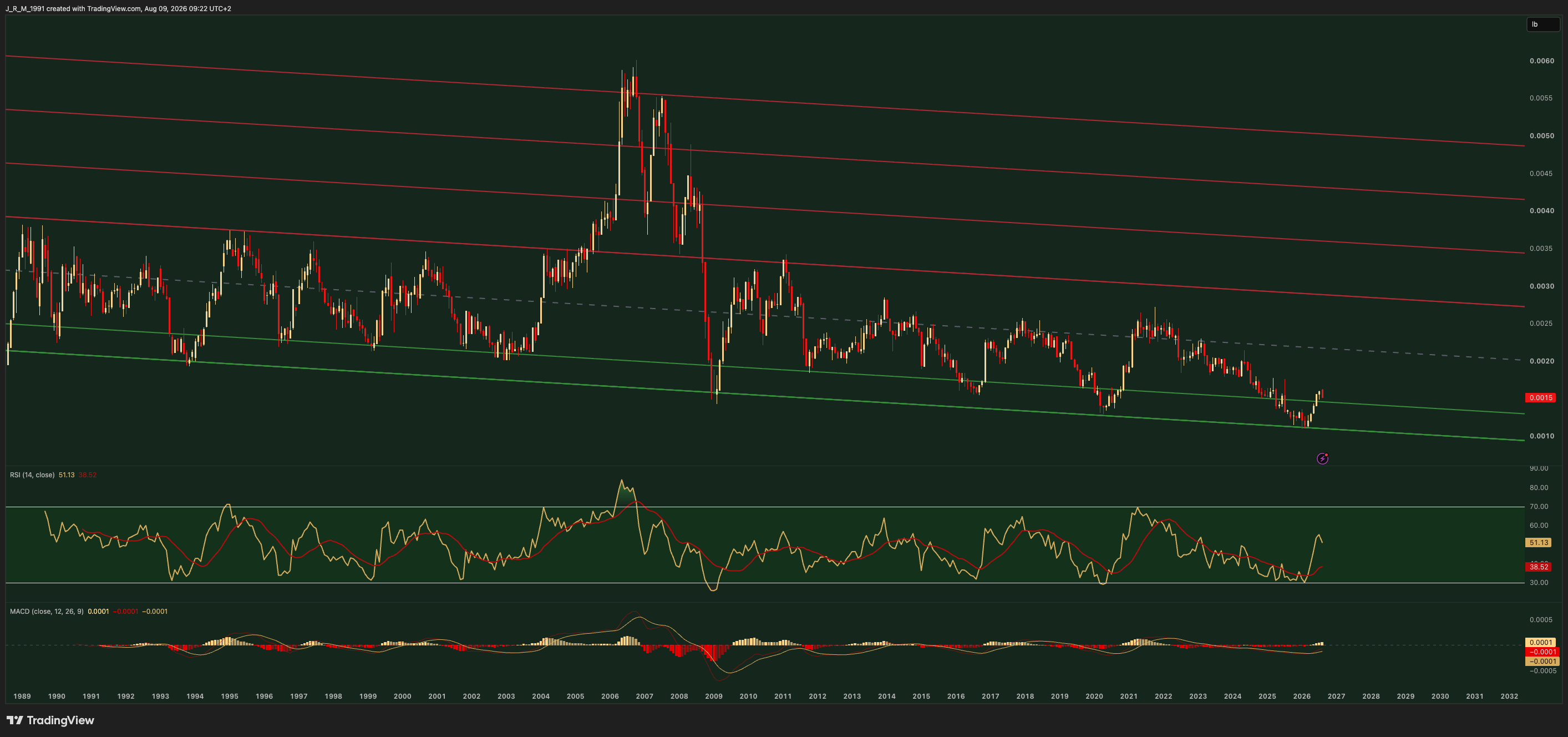
Copper-to-gold ratio as of 07/07/2026
A few months later, copper has indeed outperformed by 40%, but remains undervalued relative to the precious metal, as reaching the ratio’s long-term trend would imply another 40% upside move, not to mention any possible overshoot.
Here is why I continue to overweight copper producers in my portfolio relative to gold miners.
ALUMINUM & NICKEL
While we’ve seen how cheap copper is relative to gold, other industrial metals, such as aluminum and nickel, display an even more pronounced cheapness.
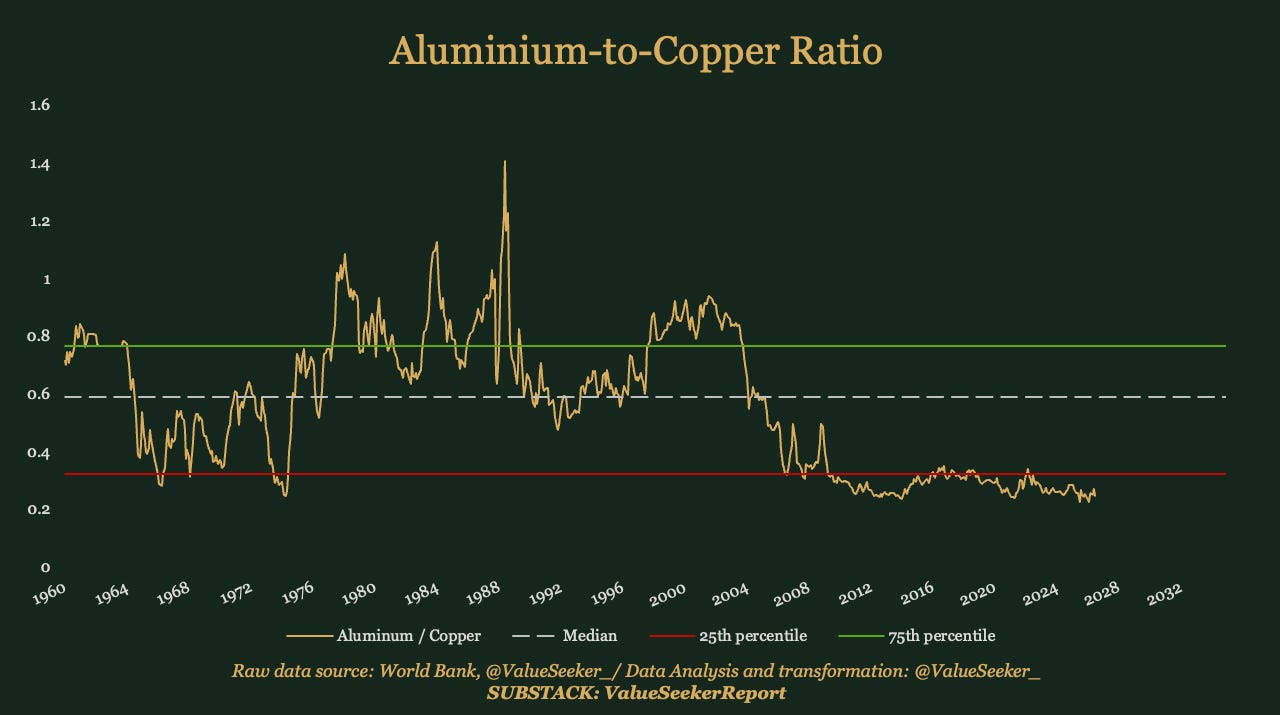
Indeed, with an aluminum-to-copper ratio trading on its 2nd percentile, aluminum seem to have (by far) the best risk-reward of the two (on a relative value basis).
Historically, aluminum has indeed been more expensive than copper 98% of the time, thus is now more likely to catch-up from here.
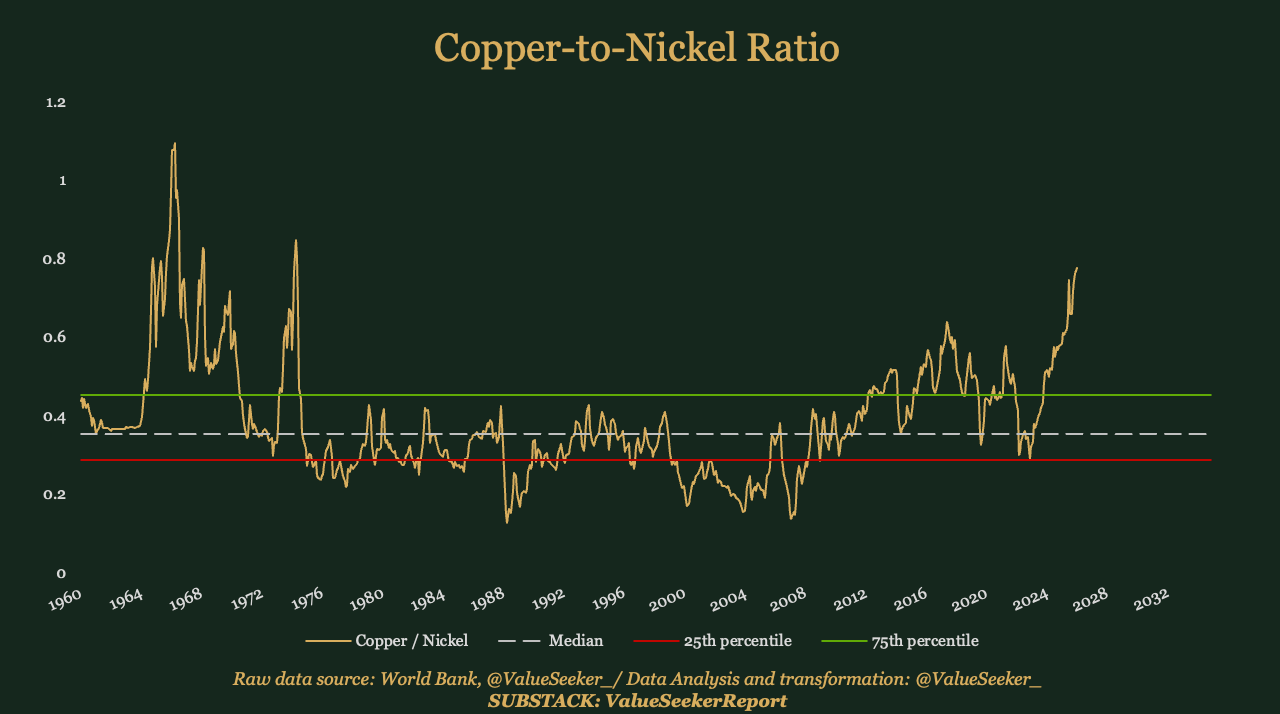
Also, with a copper-to-nickel ratio trading on its 98th percentile, nickel seems to be in a similar situation that aluminum, as it has been more expensive than copper 98% of the time, and seems to be a good candidate for a catch-up move.
To what extend?
Well, reaching both ratios’ medians would imply the following payoffs:
• Aluminum relative to copper: +140%
• Nickel relative to copper: +130%
So, while copper is already cheap relative to gold, aluminum and nickel are even cheaper, providing an even more asymetric risk-reward.
A REMINDER
At this point, the reader should remember that I am not here mentioning absolute, but relative performances & valuations.
This means that:
• While gold is more expensive than industrial metals, one could still keep it in portfolio, simply with a lower weight than copper, aluminum or nickel.
• If gold were to rise further, the absolute performance of those industrial metals would increase as well.
TO CONCLUDE
While I can’t predict with certainty upside moves, I can adjust my portfolio weight to optimize its risk-reward over time, and generate excess return, without letting emotions being involved in my decision making process.
Not all metal exposures of my portfolio were mentioned here today, for simplicity.
Don’t forget to subscribe to receive article about investment strategies and other components of my portfolio.